Signer identity security: OTPs, personal links, roles, and the danger of shared accounts
An electronic signature is only as strong as the way the system makes sure the person signing is the intended person. On docs.resmi.id, signer identity is protected by a personal link for each person, a one-time OTP code sent to email or WhatsApp, and a signing order and roles that limit who can do what. These layers can collapse when accounts, email addresses, or links are shared.
 Resmi.ID Team · 6 min read ·
This article explains how each layer works, the signer's legal duty to keep it secure, and the habits your team should avoid.
What the law says about signer identity
Article 59(3) of GR 71/2019 requires that the signature creation data is linked only to the signer, is under the signer's sole control during signing, and that there is a specific way to identify who the signer is. Article 61(4) adds that the signer must keep their signature creation data confidential and is responsible for it.
Article 12 of the EIT Law also requires everyone involved in an electronic signature to secure it, including making sure the system cannot be accessed by unauthorised people and that the signer exercises due care. A signer who learns that their data has been compromised must promptly notify those who rely on the signature or the service provider. Anyone who breaches this is liable for all resulting losses and legal consequences.
The security layers on docs.resmi.id
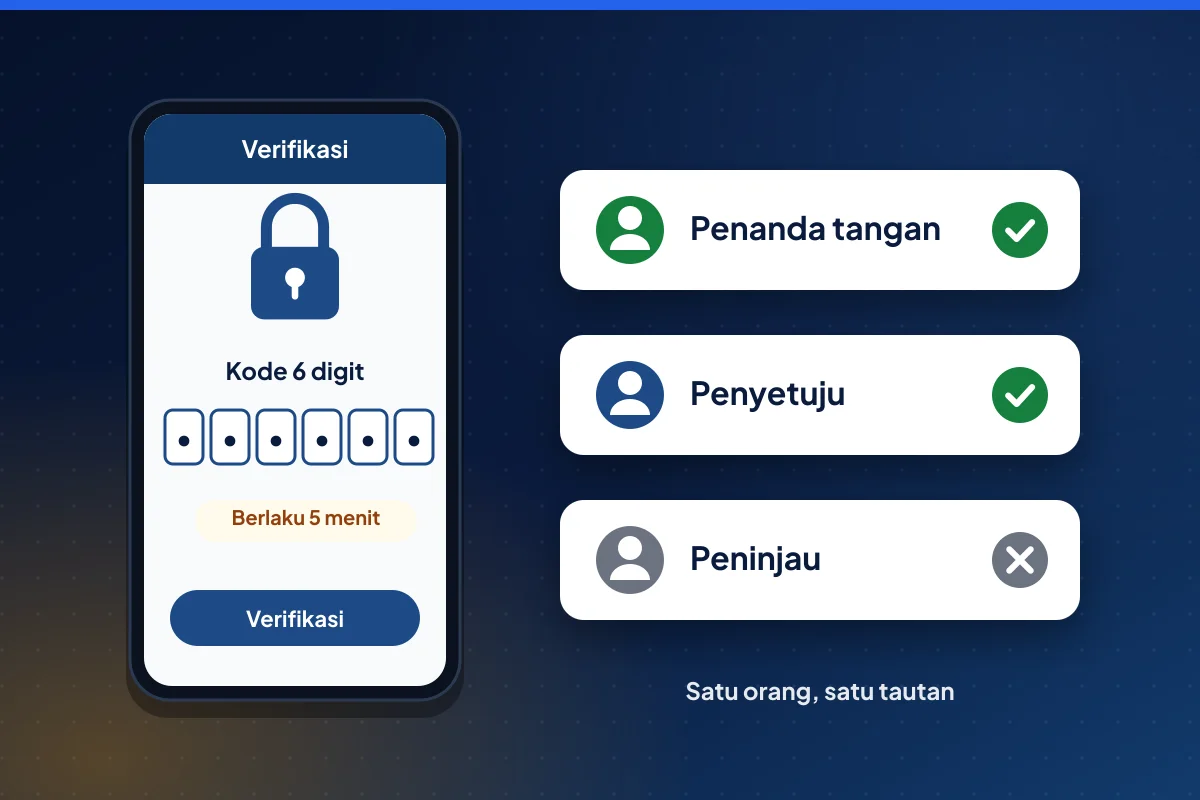
- 1Personal linkEach signer receives a unique link by email. The token inside it is randomly generated, stored on the server as a hash, and has a limited lifetime.
- 2One-time OTPBefore signing, the signer enters a 6-digit code sent to email or WhatsApp. The code is valid for 5 minutes with a limit of 5 attempts, and is stored as a hash.
- 3Code request limitsA new code can only be requested after a 60-second wait and the number per day is capped, so repeated guessing is ineffective.
- 4Signing orderIn sequential mode, a signer whose turn has not come cannot sign, and links stop working for documents that are completed or cancelled.
- 5Clear rolesSigners and approvers must complete their part, while reviewers only receive a copy and can neither sign nor decline the document.
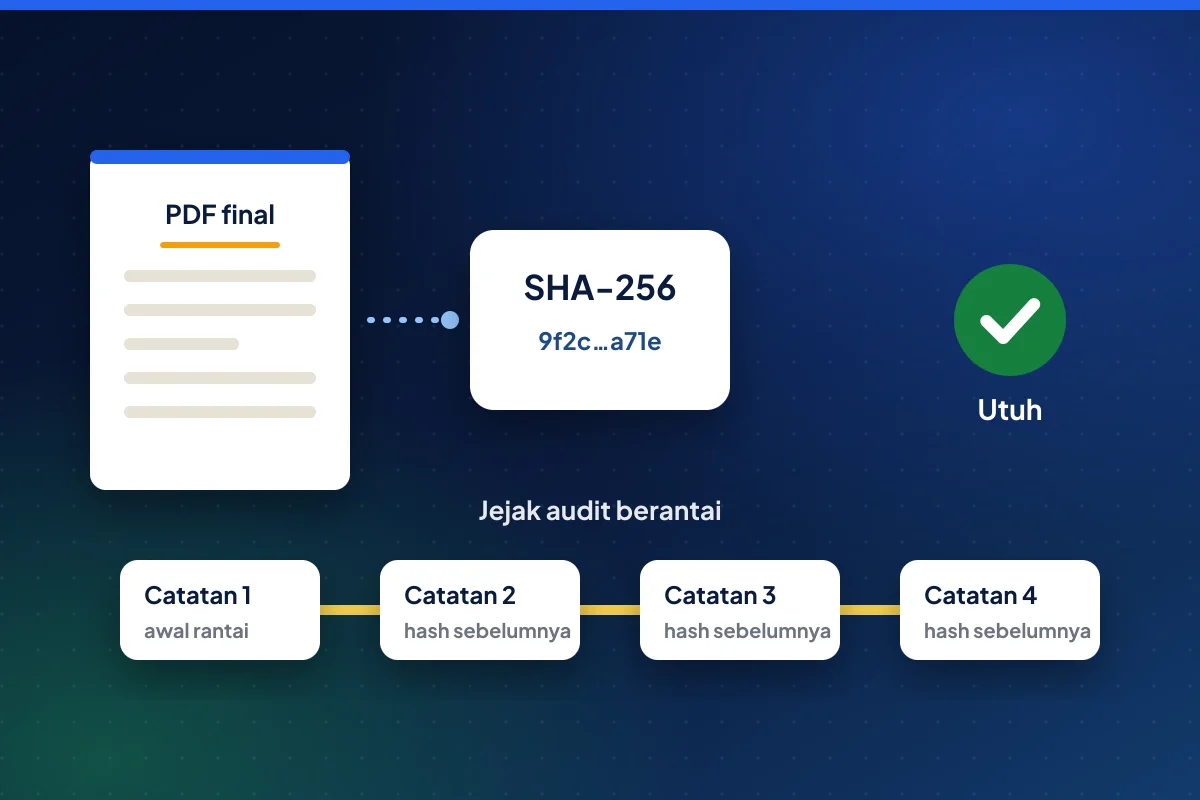
- 6Verification channel recordThe audit trail records the verification method and the OTP channel actually used, along with the time, IP address, and device.
The sender can also choose no OTP for a particular signer. This is faster, but the evidence then rests only on who can open that email. Use it only for very low-risk documents.
These layers are also designed not to get in the way of legitimate signers. If a WhatsApp code does not arrive, the signer can request a new code or choose another channel, and the channel finally used is still recorded. Before signing, they can open and download the document to read it first. If they disagree, they can decline and write down their reason, and that decline also goes into the audit trail. All of this strengthens the requirement that the signer understands the document and consents knowingly.
The danger of sharing accounts, email, and links
Sharing often happens for practical reasons, but it directly affects evidentiary value. When several people use one identity, the audit trail still looks tidy, yet it can no longer answer who actually approved the document.
- The sender's Resmi.ID account is used by several staff in turn. Every document appears to come from the same person, and anyone who knows the password can create documents on behalf of the business.
- Signing links are sent to a shared mailbox such as an admin or finance address. Anyone reading that inbox can receive the OTP and sign.
- A signer forwards the link or OTP to an assistant to sign on their behalf. In evidence, the record still shows the signer's name, even though they did not do it themselves.
- The WhatsApp number entered is no longer active or belongs to someone else, so the code ends up in the wrong hands.
Example: a director asks their secretary to sign all supplier contracts because the links and OTPs arrive at an office email that the secretary also reads. When one supplier disputes a contract, the director says they never approved a particular payment term. The audit trail shows the OTP was sent to the director's email and the signature was applied in their name, so it becomes hard for the company to deny it. If the secretary is in fact authorised, the right approach is to give them a written power of attorney and invite them as a signer with their own name and email.
Good practice for document senders
- Invite each person using their own personal email and WhatsApp number, not a shared address.
- Turn on OTP for every signer, especially external parties and high-value documents.
- Confirm external parties' email addresses and WhatsApp numbers through a channel you already know before sending.
- Choose roles carefully: internal approvers before the main signer, and reviewers for parties who only need a copy.
- Use sequential mode when internal approval must be completed before the document reaches the external party.
- Make sure every staff member uses their own Resmi.ID account and never shares a password.
When identity needs to be strengthened further
An OTP proves the signer controls a particular email or number, not that their identity has been checked against civil registration documents. Signatures on docs.resmi.id are uncertified electronic signatures. For high-risk transactions, Law 1/2024 added Article 17(2a) to the EIT Law, which points to electronic signatures secured with an electronic certificate, where initial identification is carried out by an Electronic Certification Provider.
For everyday business documents, the combination of personal links, OTPs, signing order, roles, and the audit trail on docs.resmi.id provides a sound evidentiary basis. The key is your team's discipline: one person, one identity, one link.
Put these rules in writing and repeat them whenever new staff join. Identity security rarely fails because of technology; it usually fails because of a shortcut taken by someone in a hurry. A short reminder before sending an important contract is often enough to prevent the costliest mistakes.
References
- JDIH BPK — UU Nomor 11 Tahun 2008 tentang Informasi dan Transaksi Elektronik
- JDIH BPK — UU Nomor 1 Tahun 2024 (Perubahan Kedua UU ITE)
- JDIH Kemenkeu — PP Nomor 71 Tahun 2019 tentang Penyelenggaraan Sistem dan Transaksi Elektronik
This information is general and not legal advice. For important decisions, check the latest regulations at official sources or consult a legal professional.