Archiving and auditing e-stamped documents: registers, serial numbers and retention periods
Affixing an e-Meterai is only half the job. The other half is keeping the document in a way that lets you prove the stamp duty was validly paid whenever you are asked, whether by an internal auditor, a tax auditor, a partner or a court. A tidy archive is what makes the benefit of e-Meterai real: the proof that the document tax was paid sits inside the file itself.
 Resmi.ID Team · 5 min read ·
This article covers what to keep, for how long, and how to prepare an archive of electronically stamped documents so it is ready for review. The focus is stamp duty; for the signature audit trail, see our article on audit trails for electronic documents.
Why the archive of stamped documents matters
Article 44(2) of PMK 78/2024 states that stamp duty paid with e-Meterai is valid if affixed through the Electronic Stamp System and carrying a unique code and specified information. The unique code can be scanned and shows at least a 22-character alphanumeric serial number (Article 17). If these conditions are not met, Article 45 states the document is deemed unstamped. Article 46 also empowers the Director General of Taxes to determine the validity of a stamp at the request of the party liable or another party.
This means your best evidence is the original, intact stamped PDF, plus records linking the stamp's serial number to the business transaction.
How long to keep it
- Article 28(11) of the General Tax Provisions Law (UU KUP) requires books, records and documents underlying bookkeeping, including electronically managed data, to be kept for 10 years in Indonesia. Stamped contracts and receipts generally count as supporting documents for bookkeeping.
- Article 23 of Law 10/2020 states that stamp duty owed expires five years after it became payable.
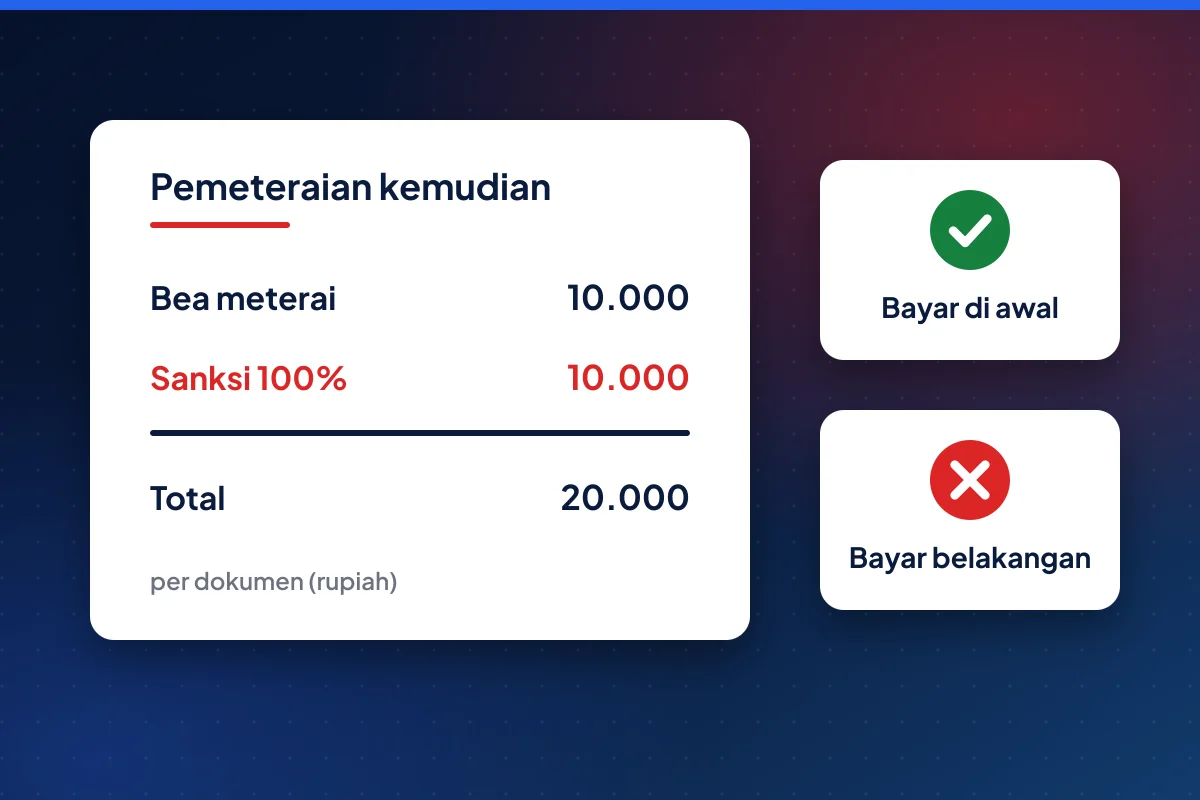
- Documents used as evidence in court do not need late stamping if their stamp duty was properly paid, so keeping the original stamped version saves money later.
Because the tax retention period is longer than the stamp duty expiry period, treat 10 years as the minimum for stamped documents linked to your bookkeeping, unless your adviser recommends longer.
Keep files in their original format, namely the PDF downloaded from the system, and name them consistently, for example by combining the year, document type and document number. Uniform naming makes searching easier years later, when the staff who created the files may have moved on.
Building a register of stamped documents
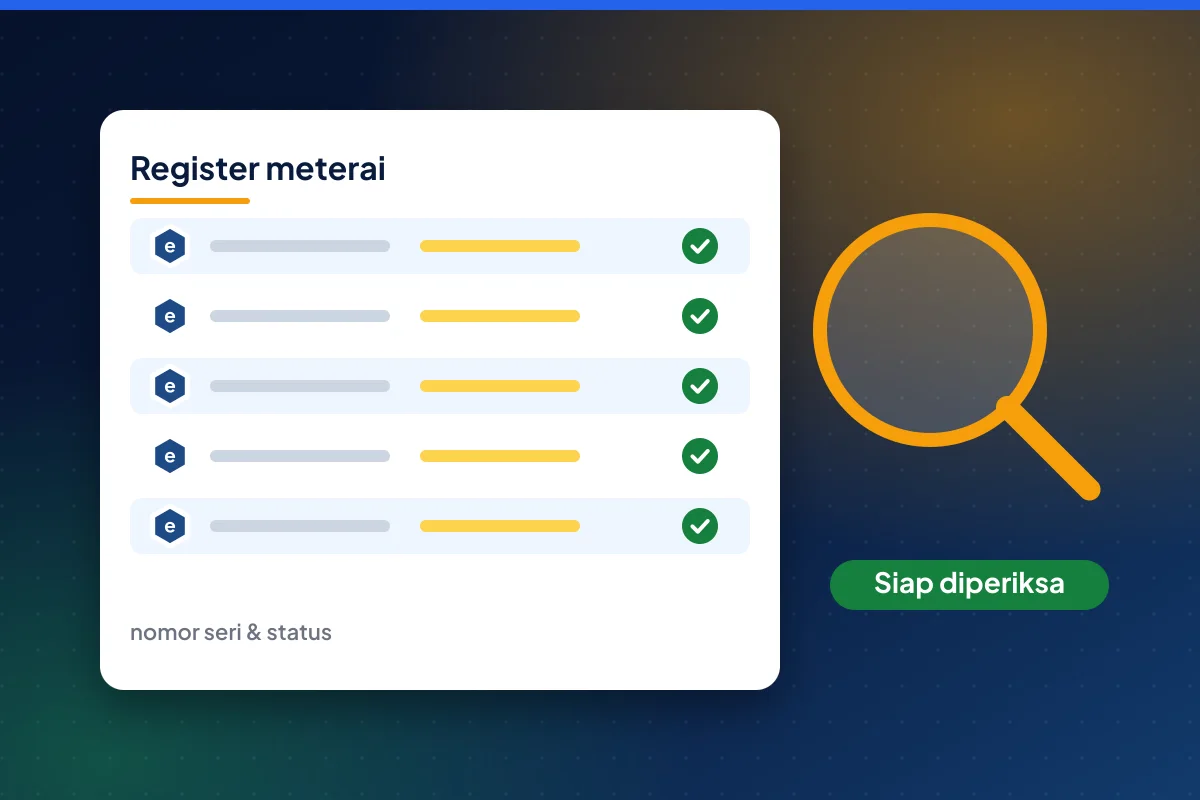
A register is a simple table linking each e-Meterai to its document. It can be a spreadsheet or a table in your accounting system. Suggested columns:
- 1Document numberThe contract, invoice or receipt number, which is also recorded with the stamp.
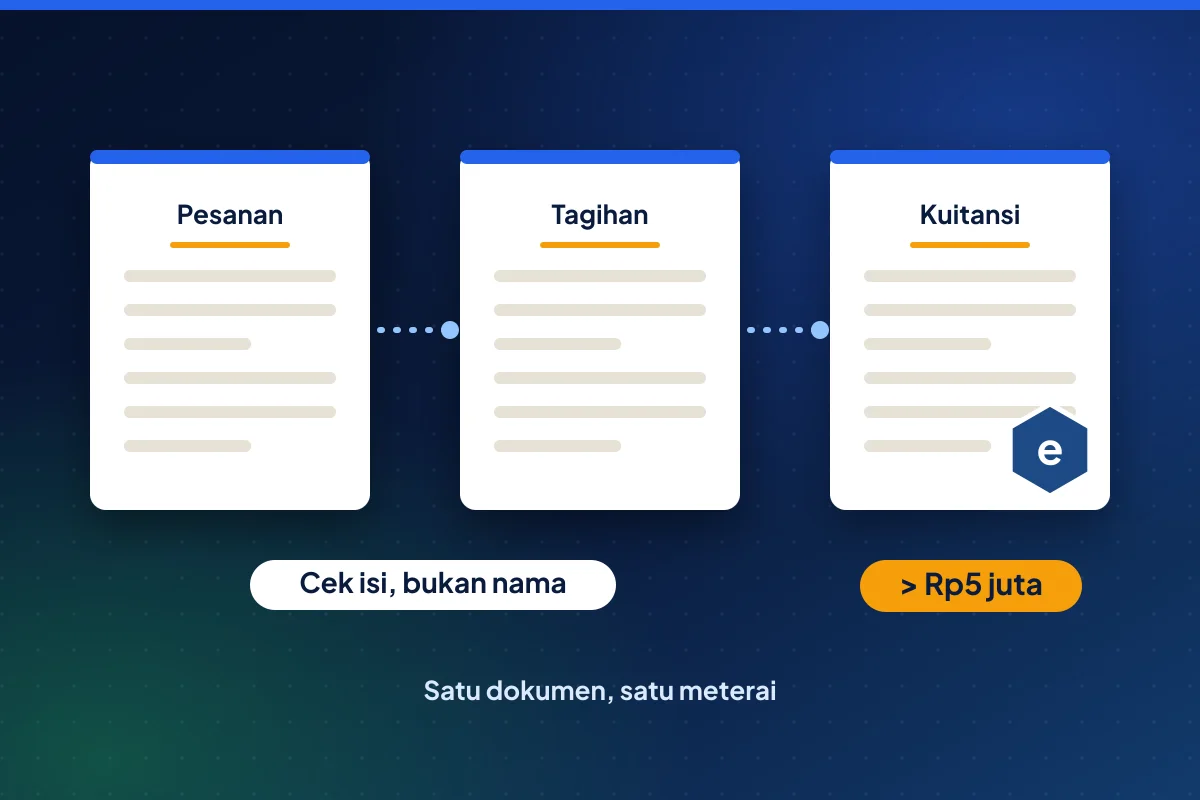
- 2Document typeThe category chosen when stamping, for example agreement or receipt of money above Rp5,000,000.
- 3Value and partiesThe transaction amount, the counterparty's name and the party bearing the duty as agreed.
- 4Date duty aroseThe signing date for agreements, or the handover date for receipts.
- 5e-Meterai serial numberThe 22-character serial number recorded on the stamp.
- 6File locationThe folder or system where the final PDF is stored, plus its verification code.
For example, a finance company stamps around 300 agreements a month. With a register, the finance team can answer an auditor's question such as whether a particular customer's agreement has been stamped within minutes, without opening hundreds of files one by one.
Keeping files intact
- Keep the final PDF downloaded after all parties have signed and the e-Meterai has been affixed, not a draft or a scanned printout.
- Do not open and re-save the PDF in an editing application. Even a tiny change makes the stamp's digital signature read as invalid.
- Keep backups in at least two locations with restricted access, such as internal storage and the company's cloud storage.
- Limit who may delete files, and record every transfer of the archive.
Regular checks
Once a month or once a quarter, match the transaction list in your books against the register. Receipts above Rp5,000,000 or contracts without a serial number in the register are a sign that a document was missed. The sooner it is found, the sooner it can be resolved, for example through late stamping, before it becomes an audit finding.
Also pick a random sample of files and open them in a PDF reader that shows the signature panel, such as Adobe Acrobat Reader, to confirm the stamp still reads as valid and the file has not changed since stamping.
Keep a brief record of each periodic check: the date, the number of documents reconciled, the findings and the follow-up. This record shows auditors that your stamp duty compliance is monitored routinely, not only tidied up when an audit arrives. Keep it alongside the register so it is easy to find.
When an auditor asks for proof
When an auditor or tax auditor asks about stamp duty on a set of transactions, an organised archive makes the answer quick and consistent. A practical sequence:
- Look up the transactions in question in the register, and note the document number, the date duty arose and the e-Meterai serial number.
- Provide copies of the original PDF files, not screenshots or printouts, so the stamp and its digital signature can be checked.
- Include the document's verification code or link if the auditor wants to confirm authenticity independently.
- For any transaction found to be unstamped, acknowledge it early and settle it through late stamping rather than waiting for it to be set out in a tax assessment.
How docs.resmi.id helps
On docs.resmi.id, the serial number of every e-Meterai is recorded in the document's audit trail, alongside the signing events. The audit trail can be filtered by activity type, including e-Meterai, and exported to CSV to reconcile with your register. Every final document also has a verification code and QR on each page, and its audit records are linked by a hash chain so changes to the records can be detected. For e-Meterai via the API, the result returns the stamped file together with its serial number so it can be stored directly in your system.
With a tidy register, intact original files and regular checks, your electronically stamped documents are not only valid when created but also easy to prove years later.
References
- JDIH BPK — PMK Nomor 78 Tahun 2024 tentang Ketentuan Pelaksanaan Bea Meterai
- JDIH BPK — UU Nomor 10 Tahun 2020 tentang Bea Meterai
- DJP — UU Nomor 28 Tahun 2007 tentang Ketentuan Umum dan Tata Cara Perpajakan (Pasal 28)
This information is general and not legal advice. For important decisions, check the latest regulations at official sources or consult a legal professional.