Late stamping and the 100 percent penalty: the cost of forgetting to stamp business documents
What happens if a business contract or receipt that should carry a duty stamp was never stamped? The document generally remains valid, because stamp duty is a tax on documents, not a condition for an agreement to be valid. But the tax does not disappear. The shortfall must be settled through late stamping (pemeteraian kemudian), and for documents that were taxable from the start there is an administrative penalty of 100 percent of the duty owed.
 Resmi.ID Team · 5 min read ·
This article explains when late stamping is needed, how much it costs, how the procedure works under PMK 78/2024, and how e-Meterai helps you avoid getting there.
When late stamping applies
Article 17 of Law 10/2020 and Article 47 of PMK 78/2024 state that late stamping applies to two types of documents:
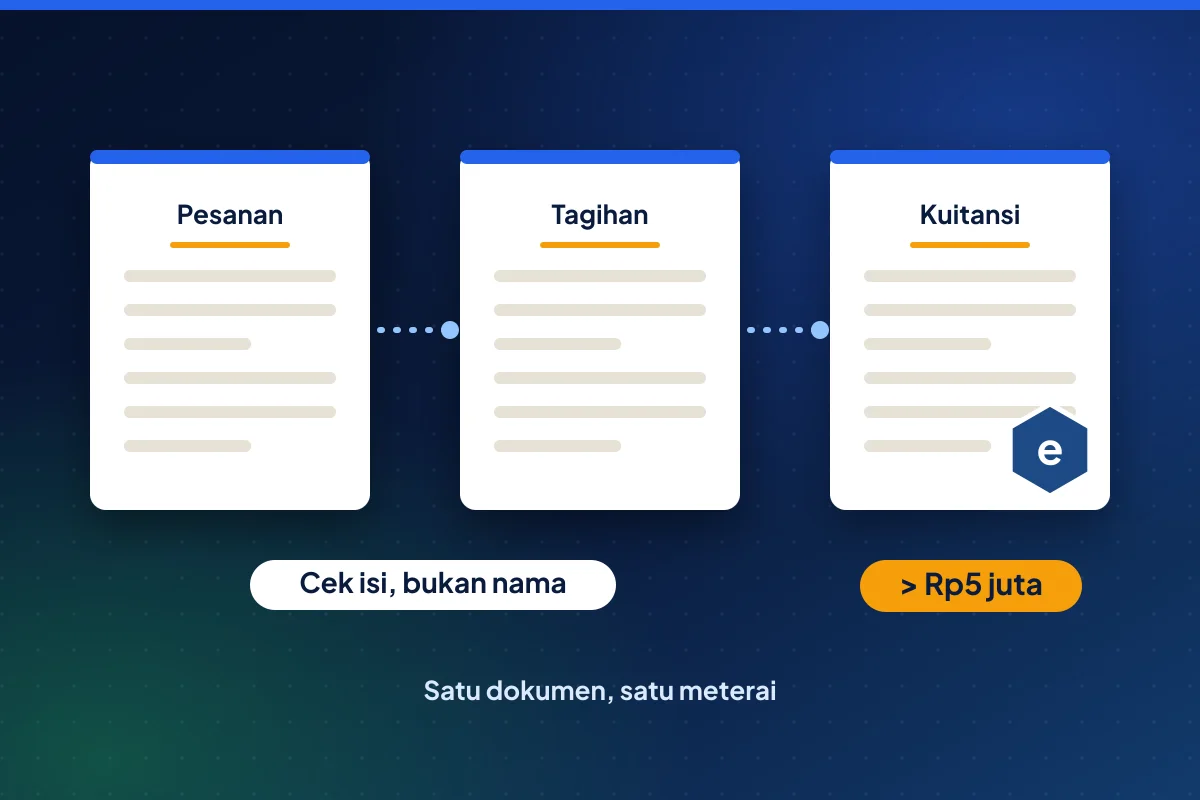
- 1Underpaid documentsTaxable documents whose stamp duty was not paid or underpaid, for example a Rp25,000,000 receipt handed over without a stamp.
- 2Documents used as court evidenceDocuments to be submitted as evidence, including documents that were not originally subject to stamp duty, such as delivery notes or internal records.
The elucidation of Article 3 of Law 10/2020 confirms that documents whose stamp duty has been properly paid do not need late stamping when used as evidence in court. This is one of the practical benefits of stamping documents from the outset.
How much it costs
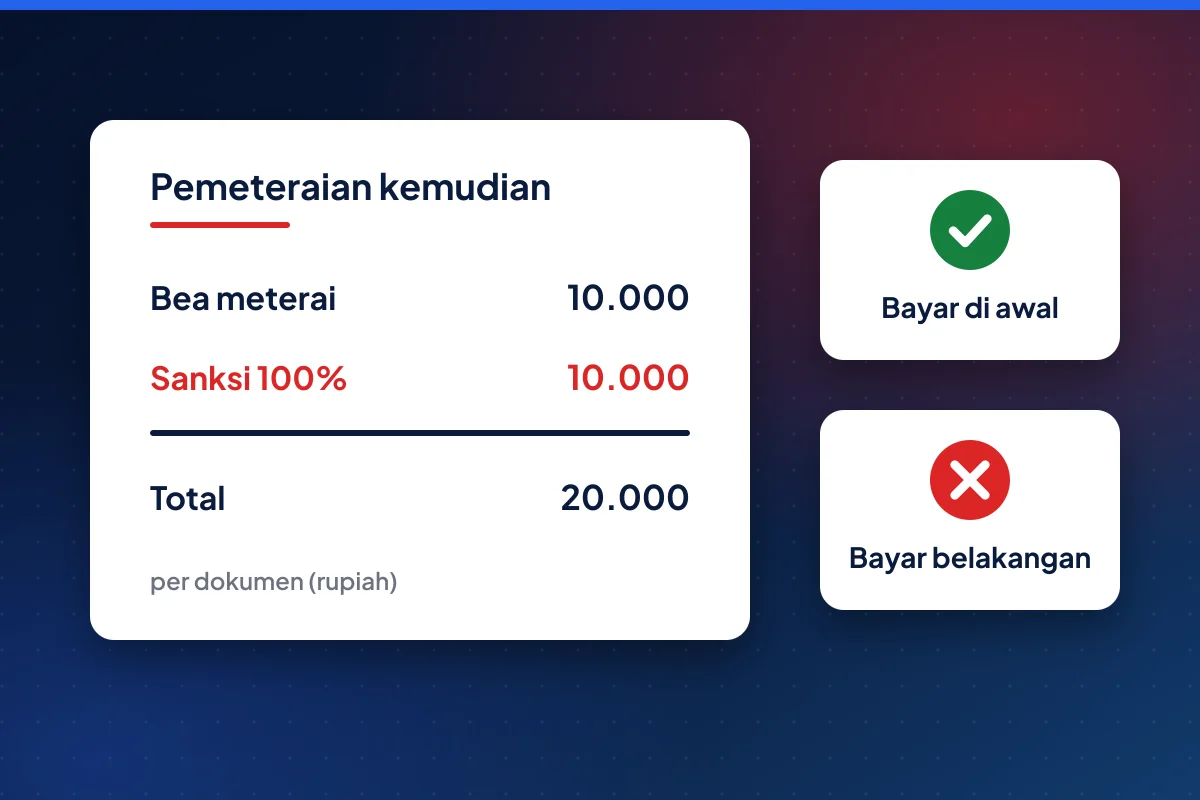
Article 18 of Law 10/2020 and Article 49 of PMK 78/2024 set the amounts. For underpaid documents on which duty became payable from 1 January 2021, you pay the duty owed plus a 100 percent administrative penalty. For underpaid documents on which duty became payable before 1 January 2021, the penalty is 200 percent. For documents used solely as evidence in court, you pay only the duty in force when late stamping is carried out, with no penalty.
Example calculation: a distributor finds 12 sales receipts above Rp5,000,000 from 2026 that were handed over without a stamp. The duty owed is 12 x Rp10,000 = Rp120,000, plus a 100 percent penalty of Rp120,000. The total is Rp240,000, twice what it would have cost to stamp them on time.
The procedure under PMK 78/2024
- The party liable to pay is the party that owes the stamp duty (Article 48). The elucidation of Law 10/2020 notes that in practice the document holder may also pay it.
- The duty can be paid with a paper stamp, e-Meterai or a tax payment slip, while the administrative penalty is paid with a tax payment slip or equivalent (Article 50).
- Late stamping of more than 50 documents is paid with a tax payment slip accompanied by a list of documents (Articles 42 and 43).
- Payment is endorsed by a Post Office official for paper stamps, or by a tax office (DJP) official for paper stamps, e-Meterai or tax payment slips, by applying a late-stamping seal (Article 51).
- If the shortfall is found through an audit, the tax office may issue a tax assessment including the penalty (Article 52).
Article 42 of PMK 78/2024 also allows stamp duty to be paid with a tax payment slip when an e-Meterai cannot be affixed because the Electronic Stamp System cannot be accessed or does not respond. So a system outage is no reason to leave a document unstamped; there is a valid fallback payment route, and the document still needs to be accompanied by proof of payment.
Risks beyond the penalty
Article 21 of Law 10/2020 prohibits authorised officials, including judges, court clerks, notaries, land deed officials and civil servants, from accepting, considering or keeping taxable documents whose stamp duty has not been paid. In practice, a document with unpaid duty may be held up just when you need it, for instance when it is submitted to a notary or a government agency.
There is also the risk of using the wrong form of stamp. Article 45 of PMK 78/2024 states that payment is invalid and the document is deemed unstamped if the validity requirements are not met. For e-Meterai, the requirements are that it is affixed through the Electronic Stamp System and carries a unique code and specified information (Article 44). An image of a stamp pasted onto a PDF does not meet them.
Example: an old contract suddenly needed
For example, a company signed a warehouse lease in 2024 without a stamp because it was in a hurry. Two years later, the warehouse owner sues over a rent increase, and the lease has to be submitted as evidence. Because the lease is a taxable document on which duty became payable when it was signed in 2024, the company must carry out late stamping: Rp10,000 of stamp duty plus a 100 percent penalty of Rp10,000, and then obtain endorsement with a late-stamping seal from the competent official.
The amount is small, but the time is not. The endorsement has to be arranged precisely when the team is busy preparing the case. Compare that with an agreement signed on docs.resmi.id with e-Meterai from the start: the final file is already stamped, its serial number is recorded in the audit trail, and the document can be used straight away with no extra steps.
Expiry is not a strategy
Article 23 of Law 10/2020 states that stamp duty owed expires five years after it became payable. However, the elucidation of Article 3 says documents whose duty has not been paid, including those where it has expired, must still be late-stamped if they are to be used as evidence in court. Waiting for expiry is not a safe way to manage the risk on important documents.
Preventing it with e-Meterai from the start
- 1Define mandatory documentsSet the document types that are always stamped, such as contracts, statements and receipts above Rp5,000,000.
- 2Stamp when the document is finalOn docs.resmi.id, e-Meterai is affixed automatically after all parties sign, so no document is completed without a stamp when that option is enabled.
- 3Automate high-volume documentsFor receipts issued by your system, use the e-Meterai API so the stamp is affixed when the document is issued.
- 4Check regularlyEach month, match the list of large receipts in your books against the documents already stamped, and late-stamp any you missed promptly.
Involve the sales and billing teams too, not just finance. They are the ones who most often hand receipts and contracts to customers, so they need to know which documents must carry a stamp before sending. A short training session and a simple checklist are often more effective than a year-end review.
In the end, stamping documents on time is the cheapest option. With e-Meterai on docs.resmi.id, the stamp becomes part of the signing workflow rather than catch-up work that risks doubling the cost.
References
- JDIH BPK — UU Nomor 10 Tahun 2020 tentang Bea Meterai
- JDIH BPK — PMK Nomor 78 Tahun 2024 tentang Ketentuan Pelaksanaan Bea Meterai
This information is general and not legal advice. For important decisions, check the latest regulations at official sources or consult a legal professional.