Receipts, invoices, POs and recurring contracts: which transaction documents need e-Meterai
In a single B2B sales cycle, a business may issue many documents: quotations, purchase orders (POs), contracts, delivery notes, invoices and receipts. Not all of them are subject to stamp duty. The key is the content of the document, not its name. Documents that record a civil event, such as agreements, and documents stating receipt of money above Rp5,000,000 are subject to stamp duty.
 Resmi.ID Team · 5 min read ·
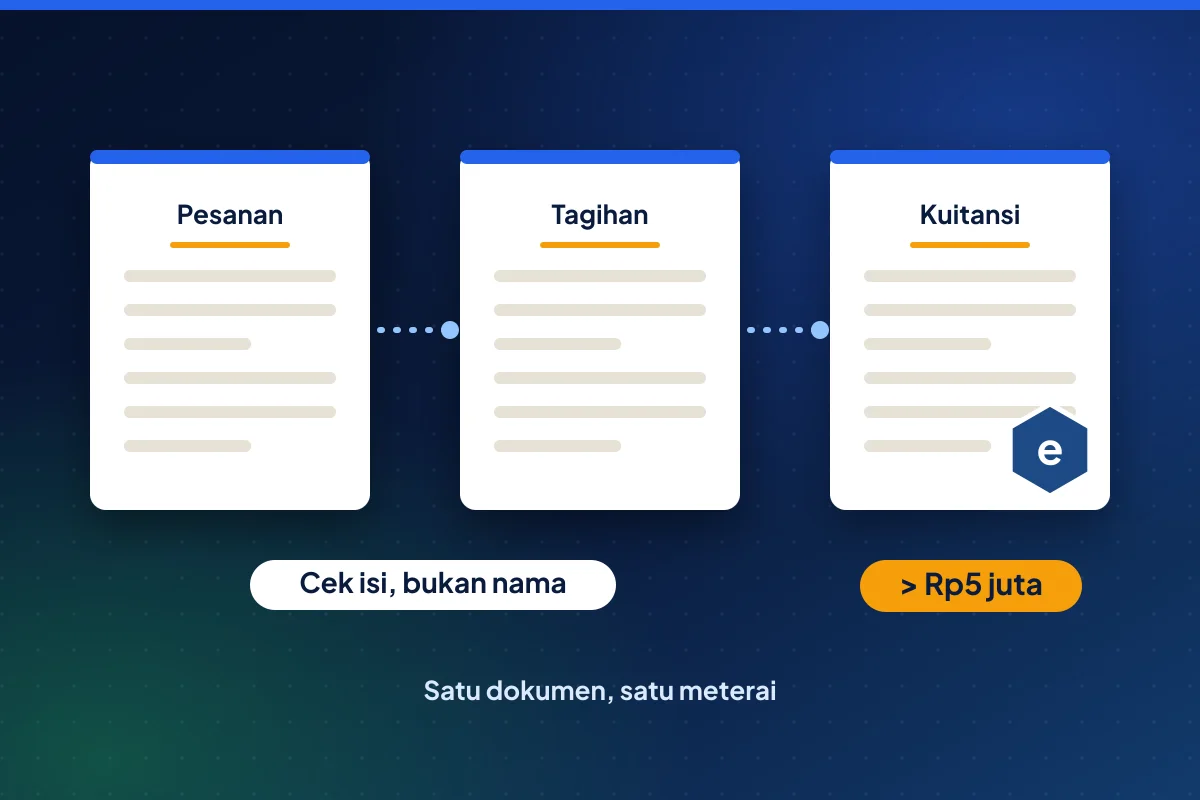
This article maps the most common transaction documents, then gives examples of how to set up e-Meterai so nothing is missed and nothing is over-stamped. For unclear cases, consult your tax adviser.
The benchmark from the Stamp Duty Law
Article 3 of Law 10/2020 imposes stamp duty on documents made to record a civil event and documents used as evidence in court. For everyday business documents, the two most relevant groups are:
- Agreements, letters of information, statements or similar letters, including their counterparts, regardless of value.
- Documents stating an amount of money above Rp5,000,000 that mention receipt of money, or acknowledge that a debt has been fully or partly paid or settled.
Article 7 also exempts a number of documents, including documents relating to the movement of goods such as consignment notes and proof of delivery or receipt of goods, as well as receipts of money made for an organisation's internal purposes.
Mapping transaction documents
- 1Contracts or master agreementsThese are agreements, so they are subject to stamp duty whatever their value. Duty becomes payable when the document is signed.
- 2Purchase orders (POs)It depends on the content. A PO signed by both parties that serves as an agreement may be treated like an agreement; decide the treatment with your tax adviser.
- 3Delivery notes and goods receiptsThese are documents relating to the movement of goods exempted by Article 7, so no stamp duty applies.
- 4Billing invoicesAn invoice that only requests payment does not yet mention receipt of money. But if it is stamped or marked paid and exceeds Rp5,000,000, its content becomes an acknowledgement of payment.
- 5Receipts or proof of paymentDuty applies if the amount exceeds Rp5,000,000. It becomes payable when the receipt is handed to the party receiving it.
Note the words above Rp5,000,000. A receipt for exactly Rp5,000,000 has not crossed the threshold, while Rp5,000,001 has. For documents in a foreign currency, the elucidation of Article 3 says the amount is converted at the exchange rate set by the Minister of Finance in force when the document is made.
Example: payment in instalments
For example, a software vendor signs a project contract worth Rp60,000,000 paid in three instalments of Rp20,000,000. The contract carries one stamp when it is signed. Each instalment receipt mentions receipt of money above Rp5,000,000, so each receipt also carries one stamp. That makes four stamped documents for one project.
Article 9 states that for one-sided documents such as receipts, stamp duty is owed by the party receiving the document, namely the payer. However, paragraph (6) allows the parties to agree who bears it. Many vendors choose to bear the e-Meterai on receipts themselves to keep things simple for customers. Whatever you choose, write it into the contract so it does not become a point of dispute.
Setting up e-Meterai for recurring transactions
The problem with recurring transactions is usually not the rules but discipline: some receipts are missed, others are stamped twice. The following habits help:
- Write down a sorting rule, for example all receipts and paid invoices above Rp5,000,000 must carry e-Meterai, while delivery notes do not.
- Save standard contracts as templates in docs.resmi.id, then enable e-Meterai each time a document is prepared.
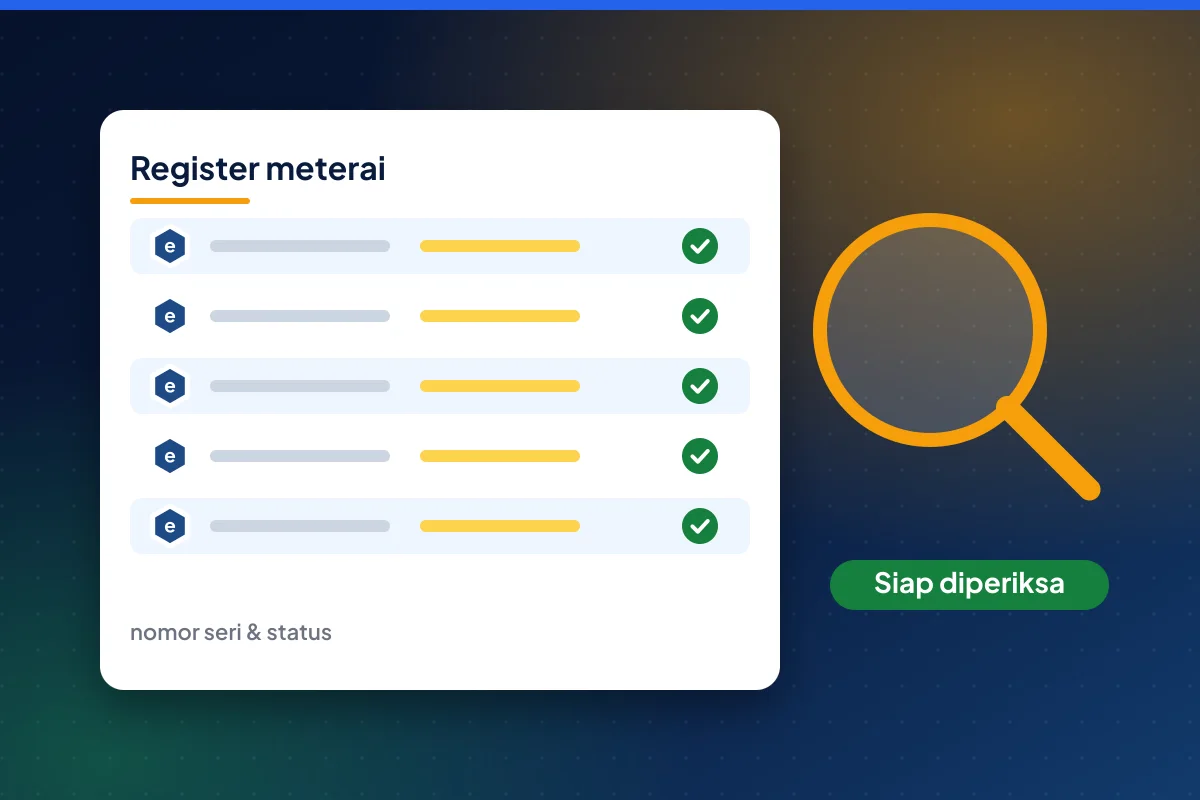
- Use consistent document numbers, because the number is recorded with the stamp and makes tracing easier.
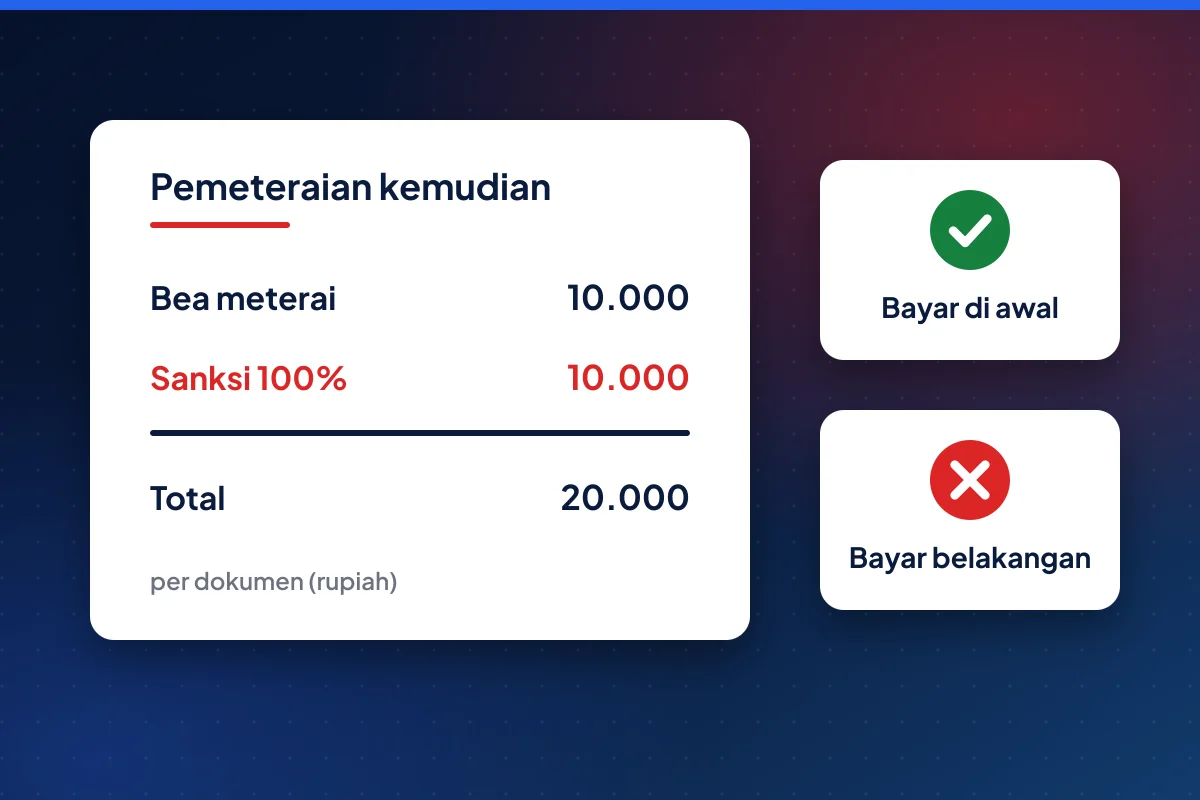
- Affix e-Meterai only to the final version. Changing the PDF after stamping invalidates the stamp, and a used stamp cannot be moved.
- If receipts are issued automatically by a POS or ERP system, use the e-Meterai API with the receipt number as the Idempotency-Key so one receipt is never stamped twice.
Choose the channel by document type. Contracts and POs that customers need to sign are best prepared in the dashboard, because the e-Meterai is affixed automatically after all parties sign. Receipts issued one-sidedly by your system are better handled through the API, so the stamp is affixed when the receipt is issued without staff involvement. Many businesses use both: the dashboard for contracts, the API for receipts.
Common mistakes with transaction documents
- 1Stamping every invoiceAn ordinary billing invoice that does not yet mention receipt of money does not need a stamp, so stamping it is a wasted cost.
- 2Forgetting instalment receiptsA stamped contract does not cover the obligation on its payment receipts. Each document is assessed on its own content and value.
- 3Adding a paid mark after stampingAdding a paid mark or an extra signature to a PDF that already carries a stamp changes the file and invalidates the stamp. Prepare the final version first.
- 4Ignoring foreign currencyReceipts in dollars or other currencies still need converting into rupiah at the Minister of Finance rate to see whether they exceed Rp5,000,000.
- 5Not recording who bears the costWithout a written agreement, the billing team and the customer may each assume the other is paying for the stamp.
Most of these mistakes can be prevented with a one-page internal policy shared by the sales, billing and finance teams, reviewed whenever the stamp duty rules change.
One document, one stamp
Article 4 states that stamp duty is imposed once for each document. This means one e-Meterai cannot cover several receipts at once, and combining many transactions into one document only makes sense if it reflects what actually happened. An honest monthly payment summary issued as a single proof of receipt is different from splitting or merging documents purely to avoid the Rp5,000,000 threshold.
On docs.resmi.id
In the docs.resmi.id dashboard, e-Meterai is affixed as part of a signing document, with document types such as receipt of money or settlement of debt above Rp5,000,000. The cost is Rp5,000 per signer plus Rp10,000 per e-Meterai, paid from your Resmi.ID business balance. For receipts that do not need anyone else's signature, the e-Meterai-only API costs Rp10,500 per stamp.
With a clear sorting rule and a tidy workflow, e-Meterai becomes a routine part of billing rather than extra work at the end of the month.
References
- JDIH BPK — UU Nomor 10 Tahun 2020 tentang Bea Meterai
- JDIH BPK — PMK Nomor 78 Tahun 2024 tentang Ketentuan Pelaksanaan Bea Meterai
This information is general and not legal advice. For important decisions, check the latest regulations at official sources or consult a legal professional.