Certified or not? How businesses choose the right level of e-signature for the risk
A business needs a certified electronic signature when the transaction is high-risk, when a rule or a partner requires it, or when you cannot confirm the other party's identity any other way. For everyday documents with low to moderate risk, an uncertified signature backed by an OTP and an audit trail is generally adequate. The key is to choose per document type, not one method for everything.
 Resmi.ID Team · 6 min read ·
Rather than repeating the legal basis at length, this article gives a decision framework that your legal, finance, or operations team can use straight away. It is general information, not legal advice.
The difference in one paragraph
Article 60 of GR 71/2019 divides electronic signatures into certified and uncertified. A certified signature must use an electronic certificate from an Indonesian Electronic Certification Provider (PSrE) and be made with a certified signature creation device. Before it is used, the PSrE must carry out initial identification of the signer, and its use applies a combination of at least two authentication factors (Article 64). An uncertified signature is made without a PSrE's services. Both are valid if they meet the six requirements of Article 59(3), but the elucidation of Article 60(2) states that the type affects evidentiary weight.
There is also the term electronic seal. Under Article 59(2), when an electronic signature represents a business entity, it is called an electronic seal. You will come across this term when a partner asks for a document to be signed on behalf of the company rather than an individual.
Five questions before you choose
- 1Is there a specific ruleCheck whether a law or sector regulation requires a notarial deed, a land deed official, or a particular form of signature. If so, follow that rule first.
- 2Is the transaction high-riskArticle 17(2a) of the EIT Law, added by Law 1/2024, directs high-risk transactions to use a signature secured with an electronic certificate. The elucidation gives the example of financial transactions not carried out face to face.
- 3How big is the loss if disputedImagine the other party denying their signature. If the loss would be large and hard to recover, raise the signature level.
- 4How well do you know the other partyA long-standing partner with a transaction history is different from a new party you only know by email.
- 5What does the other party requireBanks, government agencies, or large partners often set their own signature type and provider.
If the answer to the first or second question is yes, the decision is clear: follow the required form. The next three questions help weigh documents that are not specifically regulated. The greater the loss if a signature is disputed and the less you know the other party, the stronger the case for a certified signature, even if no rule requires it. Conversely, for low-value documents with long-standing partners, OTP verification and an audit trail are usually proportionate to the risk. Remember too that certified signatures generally take more cost and time, so using them for every document can erase part of the speed benefit you are after.
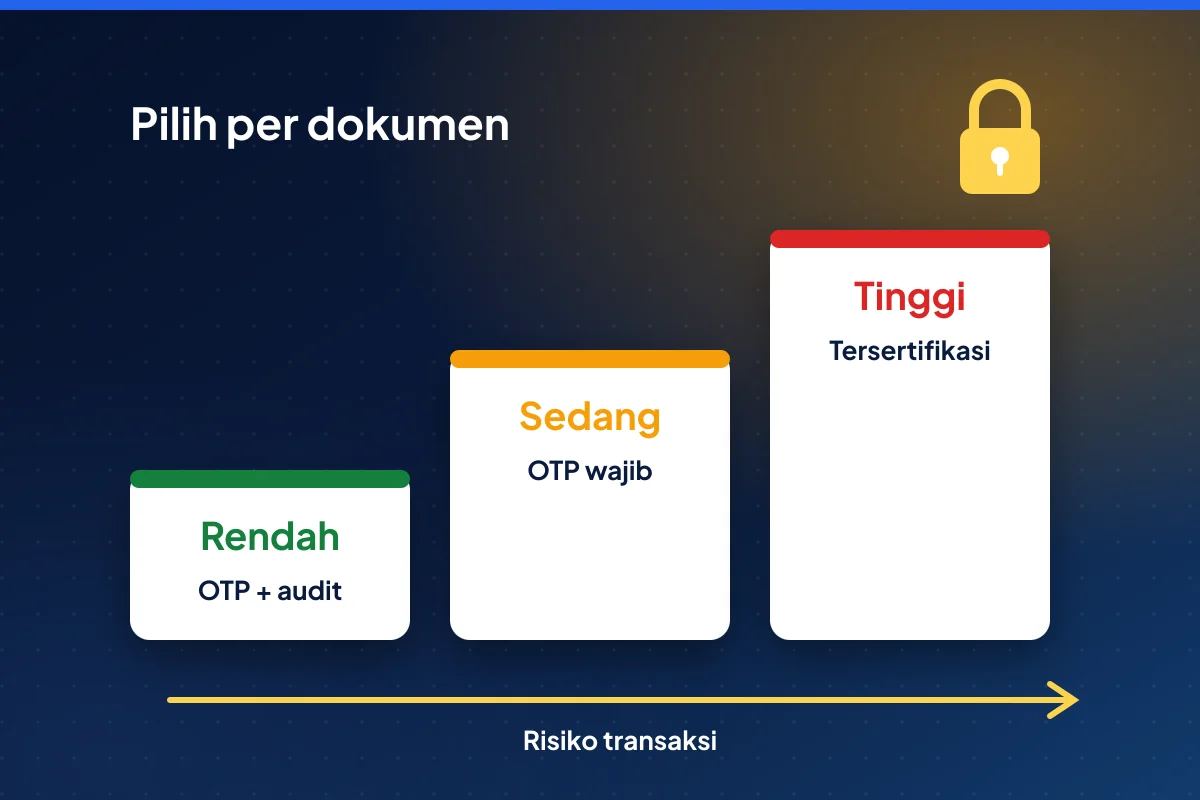
Three risk tiers as a guide
The example breakdown below can be adapted to your company policy. It is not a legal rule, but a practical way to keep your team from deciding from scratch for every document.
- 1Low riskQuotations, order confirmations, handover reports for low-value goods, internal approvals. An uncertified signature with OTP and an audit trail is generally enough.
- 2Moderate riskPartnership agreements with known partners, NDAs, employment contracts, recurring service agreements. An uncertified signature remains practical, provided OTP is mandatory for every party, the approval order is clear, and the final document and its verification code are archived.
- 3High riskRemote financial transactions, loans, guarantees, very high-value contracts with new parties, or documents that a rule or partner requires to be certified. Use a certified signature from a PSrE, or an authentic deed where required.
Example: a cleaning services company signs hundreds of monthly service contracts with office clients, dozens of employment agreements, and occasionally a working capital loan agreement with a financial institution. The service contracts and employment agreements can be handled with OTP-backed uncertified signatures, while the loan agreement follows the method set by the financial institution, which usually uses a certified signature. With this split, hundreds of routine documents are still processed quickly, while the one high-risk document gets stronger protection.
A mixed strategy is more realistic
Many businesses wrongly assume they must choose one system for every document. In fact a mixed approach is often the most efficient: high-volume documents with low to moderate risk are processed quickly, while high-risk documents go through the certified route. What matters is that the rules for splitting them are written into company policy, so they do not depend on individual judgement.
Write the split as a simple table: document type, value limit, risk tier, signature type, and the person responsible for deciding exceptions. Review the table whenever a new type of transaction appears or a partner changes its requirements. Make sure staff know where to look, so they do not send a high-risk document through the fast route just because it is more convenient.
Strengthening uncertified signatures
Because their evidentiary value rests on supporting evidence, treat uncertified signatures with discipline. On docs.resmi.id, the supporting evidence available includes:
- An OTP sent to the signer's email or WhatsApp, with the channel used recorded in the audit trail.
- A chained audit trail containing the time, IP address, and device for each event, with the chain re-checked when the verification page is opened.
- A SHA-256 hash of the final document plus a verification code and QR code on every page.
- A recorded signing order and signer roles, showing who approved first.
Use these features consistently: require OTP, avoid shared email addresses, and archive the final PDF as is. With a clear risk framework, your business can use docs.resmi.id for most daily documents and reserve the certified route only for documents that truly need it.
References
- JDIH Kemenkeu — PP Nomor 71 Tahun 2019 tentang Penyelenggaraan Sistem dan Transaksi Elektronik
- JDIH BPK — UU Nomor 1 Tahun 2024 (Perubahan Kedua UU ITE)
- JDIH BPK — UU Nomor 11 Tahun 2008 tentang Informasi dan Transaksi Elektronik
This information is general and not legal advice. For important decisions, check the latest regulations at official sources or consult a legal professional.